







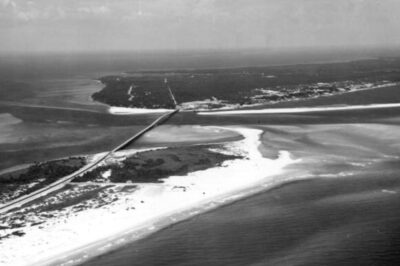


If you’ve ever looked out at East Pass and marveled at the beauty of our harbor or watched the fishing fleet head out at sunrise, you might be surprised to learn that this iconic waterway wasn’t always here. In fact, the East Pass we know today was born in 1929—thanks to a powerful storm and a few brave locals with shovels and boat oars.
Vivienne Williams, the executive director of the Destin History and Fishing Museum, tells this incredible story of local grit and ingenuity—one that quite literally reshaped Destin’s geography and laid the foundation for the vibrant fishing village we know today.
Back in 1929, a massive storm rolled through and clogged the original East Pass, which used to be located on the east side of Holiday Isle, just south of La Paz. That storm caused the Choctawhatchee Bay to rise a staggering eight feet above normal. With homes and docks on the bay side under threat, panic set in.
Many of the early settlers had built their homes on the bay side, believing it was safer than the Gulf during bad weather. But this storm proved otherwise. That’s when locals—O.T. Melvin, Dewey Destin Sr., Arn Strickland, and Dolf Weekly—decided to take matters into their own hands. Literally.
Armed with only shovels and oars, they dug a small trench between the Gulf and the Bay, hoping to relieve the water pressure. Williams compares it to “turning a fire hose onto an anthill.” Destin’s soft, sugar-white sand didn’t stand a chance. The six-foot-wide trench they created quickly widened—within days, it had expanded to over 500 feet. Locals recalled the sound of trees crashing and sand shifting, the roar of water pouring through—it was chaos, and it was loud.
When federal surveyors arrived to assess the damage, they were stunned. “They found an entirely new body of water,” Williams said. When they asked what had happened, locals shrugged and played dumb. “Nobody confessed for over 30 years,” she laughed.
That small act of desperation created what is now the modern East Pass—and its impact is still felt today. It shifted the main channel, closed the old pass, and created a protected harbor that eventually became home to the largest licensed fishing fleet in the United States. The same harbor that fuels our local economy, welcomes visitors, and supports generations of charter boat captains.
Even iconic spots like Crab Island were forever changed. The new flow of water began slamming into the island, rather than flowing around it. Over time, storms and erosion reduced it from a true island to the submerged sandbar we know and love today.
To protect the pass from filling in again, jetties were installed. “I like to joke these are the only rocks in Florida,” Williams said. And the creation of the pass didn’t just change the coastline—it changed the ecology. Choctawhatchee Bay, once primarily freshwater, became saltier. Freshwater fish moved upstream, and salt-tolerant grasses took over.
Today, the Destin History and Fishing Museum keeps this story alive. Inside, visitors can view Coast Guard charts from before and after 1929 that show how dramatically the coastline shifted. Williams even notes, “At one point in time, you could walk from Destin to Pensacola.” That walk ended when the new pass carved Holiday Isle away from what we now call Okaloosa Island.
What surprises most museum visitors is just how recent this all was. “They always assume the pass has always been there,” Williams said. But what really sticks with people is how human the story is—doing something out of necessity, only to watch it grow into something much bigger than you ever imagined.
Today, as Destin continues to grow and evolve, the story of East Pass stands as a testament to the resilience and resourcefulness of our community. It’s a reminder that one bold act, even with humble tools, can leave a legacy that lasts for generations.